



The best Inventory Breakdown feature
How does the Inventory Breakdown Feature work?
The Inventory Breakdown feature within our inventory systems allows users to divide a single stock item into multiple smaller stock items for the first time and track each resulting item individually. Inventory Breakdown is used when an item starts as one solid unit and needs to be split into smaller, usable inventory units. For example, instead of tracking quantity 1 of a solid tabletop, you can break it down into multiple individual table legs and a tabletop surface, each with its own stock item record. Each resulting item becomes independently tracked while maintaining a clear parent-child relationship to the original inventory item.
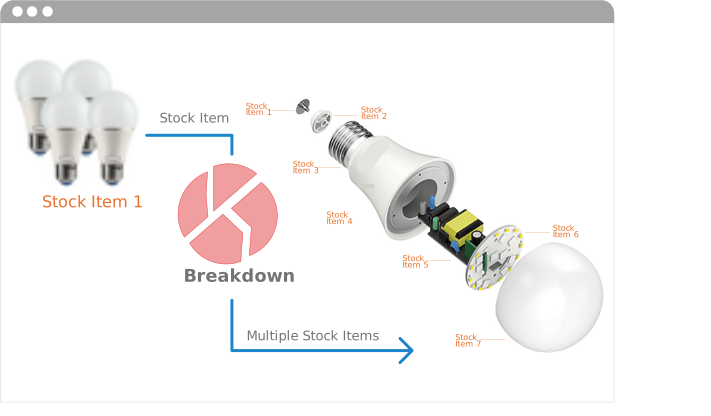
When to Use Inventory Breakdown in Real Inventory Workflows
BarCloud’s Inventory Breakdown workflow is used when a single stocked item needs to be divided into multiple smaller inventory units for the first time. This is ideal for scenarios such as splitting bulk materials into standardized units, dividing solid goods into usable components, or converting a single item into multiple trackable inventory pieces for storage, usage, or distribution across locations.
This functionality is especially useful when resulting items have different storage locations, usage rates, or replenishment needs. With this parts-level visibility, teams can eliminate “mystery shortages” and make more accurate daily inventory decisions—not just recordkeeping updates.
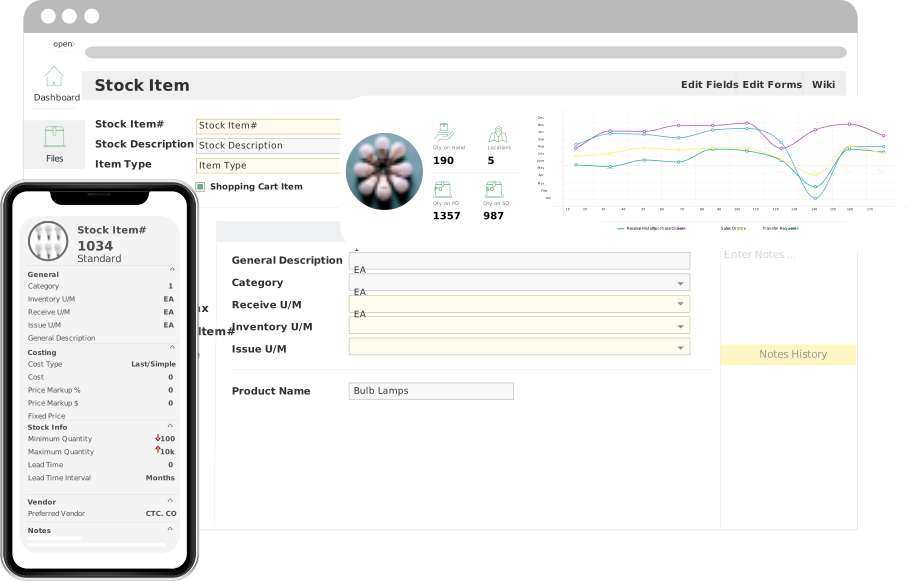
How to Use the Breakdown Inventory Feature
If you have an inventory item that begins as a single solid unit, you can use Inventory Breakdown to divide it into multiple smaller stock items. Each resulting item is assigned its own Stock Item number and quantity record, allowing it to be tracked independently within the Barcode Inventory System. Once the breakdown is complete, each item can be counted, moved, issued, or transferred separately while remaining linked to the original parent item. This allows teams to manage inventory at a more granular level while maintaining clean, accurate inventory records.
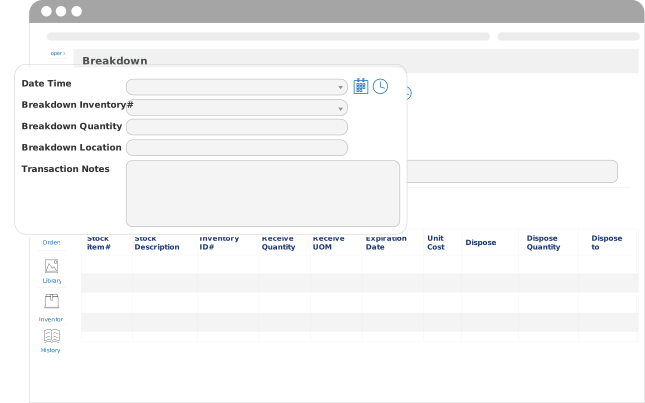
Parts-Level Inventory Tracking After Breakdown
Once a parent item is broken down, each component becomes its own tracked inventory item complete with a distinct stock item number and quantity record.
This gives you the ability to perform standard inventory actions on each component independently, including counting, moving, issuing, and transferring. As you create component listings, the quantity of the parent item is reduced, ensuring your on-hand inventory totals remain accurate.
With parts now having their own location assignments, your inventory records will match physical reality across your stockrooms and warehouses.
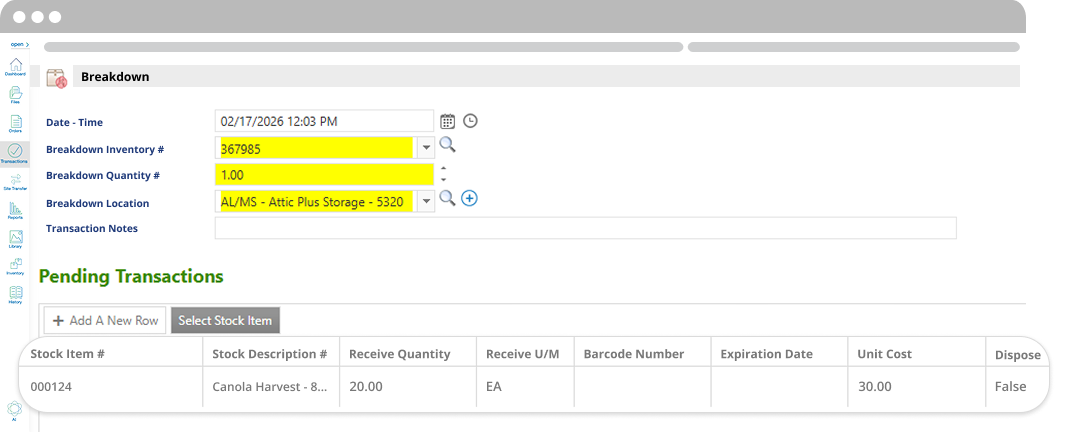
Using Breakdown Inventory Data for More-Effective Inventory Management and Planning
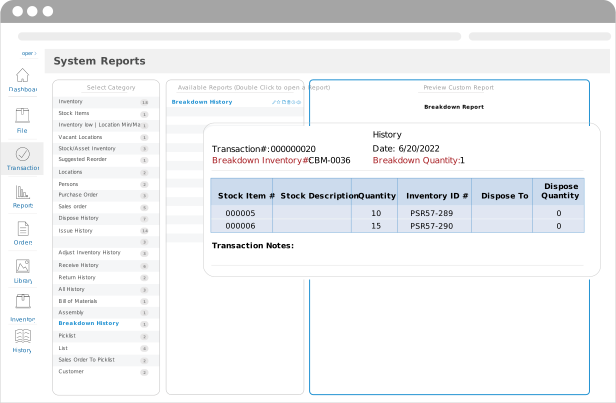
The breakdown history provided by BarCloud shows you how often parent items are converted into parts as well as which components are consumed most. Seeing these parts-level consumption trends can help your teams set more accurate reorder points for individual components, not just the parent items.
With comprehensive breakdown reports, you have a clear record for audits and internal accountability for disassembly events. Your teams will be able to review each breakdown by inventory ID, component stock item number, quantity, and location to help them spot patterns or issues.
Generate Inventory Breakdown Reports
Gain better visibility of your breakdown Inventory transactions
If users would like to acquire more visibility of their inventory breakdown transactions, our Inventory Control Software enables users to generate configurable Inventory Breakdown reports. These reports can be emailed on a preset delivery schedule if needed.
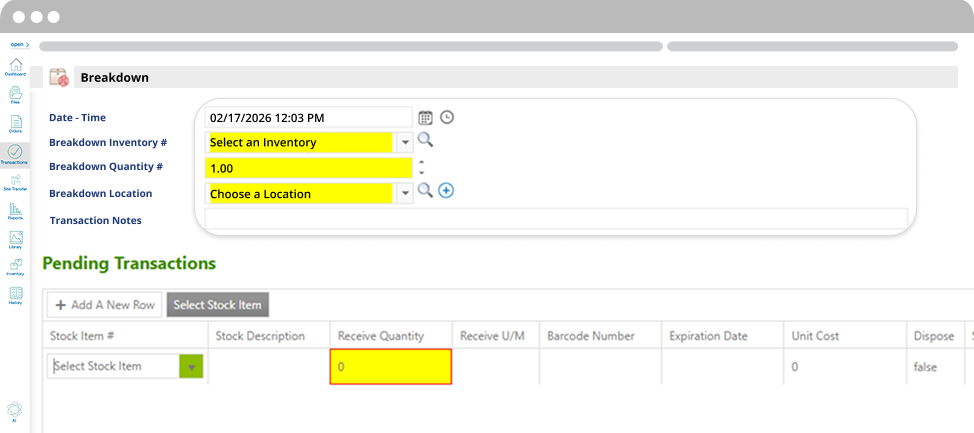
Also, if you would like to create reports on your own, you can simply fill in the fields listed below and your report will be generated:
- Inventory ID#
- Stock Item#
- Breakdown Inventory ID#
- Breakdown Quantity
- Breakdown Location
Inventory Control Benefits for Material Division and Reuse
The breakdown function in BarCloud inventory management software supports controlled reuse.
When a larger item is dismantled, the usable parts can be re-stocked and issued later without manual tracking.
A breakdown inventory for repairs can have a huge impact on your operations, as teams can remove and replace only the components they need while keeping accurate on-hand counts for each part.
BarCloud also makes it easier to rebuild kits and assemblies later because component quantities and locations are always visible.
Multi-Location Breakdown Quantity Tracking for Distributed Inventory
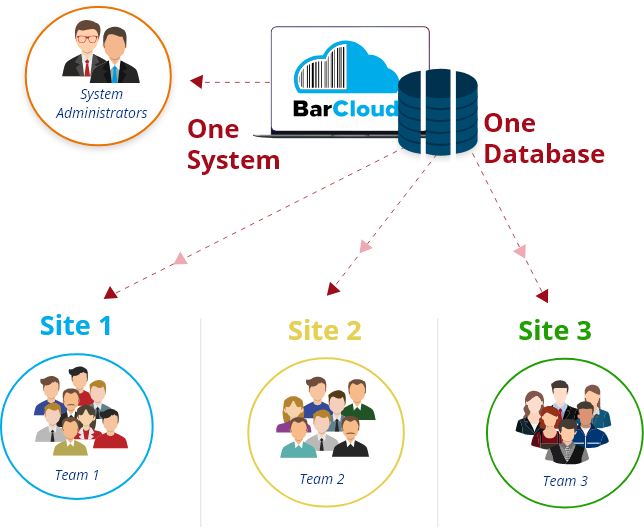
The Inventory Breakdown feature allows teams to assign each resulting inventory item to any location, enabling multi-location tracking after an item is divided.
This prevents confusion when inventory is distributed across sites and helps reduce duplicate ordering. With location-specific records, staff can see exactly where each item is stored and how quantities change over time.
FAQs
What is an inventory breakdown in BarCloud?
Inventory Breakdown is a feature that divides a single inventory item into multiple smaller stock items for the first time. Each resulting item becomes independently tracked with its own stock item number, quantity, and location while remaining linked to the original parent item.
When should a team break down an inventory item?
Inventory Breakdown should be used when a solid item needs to be divided into smaller inventory units for tracking, storage, or usage. This is common when managing bulk goods, materials, or items that must be split into standardized units.
Does breaking down inventory change the parent item’s on-hand quantity?
Yes. When an item is broken down, BarCloud automatically reduces the parent item’s quantity and increases the quantities of the resulting inventory items to maintain balanced inventory totals.
Can components be moved, issues, or transferred like normal inventory items?
Because each part is treated as a standard inventory item after breakdown, they all have their own transaction history to support ongoing inventory disassembly tracking. This includes component inventory tracking by location and including them in routine inventory transactions.
How do inventory breakdown reports help with audits or reconciliations?
Breakdown reports provide you with a clear trail of what was broken down, into what parts, in what quantities, and where those parts went. Having a complete breakdown bill of materials means you can experience faster reconciliation in the event of discrepancies as well as reduced reliance on manual spreadsheets.
Can breakdown support future re-assembly or kitting workflows?
Inventory Breakdown maintains independent tracking for each resulting item, allowing teams to see component availability. Assembly and kitting workflows are handled separately within BarCloud when applicable.